

Authored by Steel Power Shelving — Based in Brisbane, Australia’s leading shelving supplier. We are dedicated to delivering top-notch storage solutions, backed by our own local delivery team and robust after-sales support. Specializing in durable and versatile shelving, we’re committed to enhancing spaces with quality products and personalized care.
Constructing a new residential outbuilding or retrofitting an industrial workshop is a significant structural undertaking. Historically, property owners viewed the physical structure and the internal storage infrastructure as two entirely separate projects. However, modern architectural and engineering standards dictate a more integrated approach. When you decide to build a Garage with shelves from the initial blueprint phase, you unlock unparalleled operational efficiency, maximize vertical real estate, and ensure that the foundational load-bearing elements of your walls are correctly aligned to support immense static weights.
From our experience supplying commercial and residential spaces across Australia, retrofitting storage into a completed, unreinforced structure often leads to compromised safety and limited load capacities. When you plan to build a Garage with shelves cohesively, you can dictate stud spacing, electrical conduit placement, and floor coatings before a single tool is stored. We recommend treating your storage infrastructure with the same engineering rigor as the concrete slab it rests upon. In this comprehensive technical guide, we will outline the precise chronological steps required to build a Garage with shelves, ensuring your final space is safe, highly functional, and structurally sound for decades to come.
Summary Table: Core Phases to Build a Garage with Shelves
To assist project managers and DIY builders in organizing their timeline, we have summarized the critical phases required to build a Garage with shelves effectively. Adherence to this sequence prevents costly rework and structural failures.
| Phase | Execution Step | Engineering Objective | Critical Warning |
| 1. Planning | Mapping vehicle sweep paths and deep storage zones | Ensure 360-degree clearance around parked vehicles | Do not place deep shelving in the door swing radius. |
| 2. Framing | Installing structural noggins and heavy-duty wall studs | Provide secure anchoring points for heavy wall-mounted cabinets | Standard 600mm stud spacing may fail under heavy static loads. |
| 3. Flooring | Applying epoxy coatings or specialized concrete sealers | Prevent rising dampness from corroding metal base plates | Must be completed before assembling any floor-standing racks. |
| 4. Selection | Procuring industrial-grade steel storage solutions | Match the physical shelf capacity to your specific inventory | Avoid cheap plastic racking for automotive tools or heavy hardware. |
| 5. Anchoring | Mechanically fastening units to the structural frame | Prevent tipping during seismic events or accidental impacts | Never rely solely on plasterboard (drywall) anchors for heavy units. |
Phase 1: Architectural Planning and Spatial Clearance
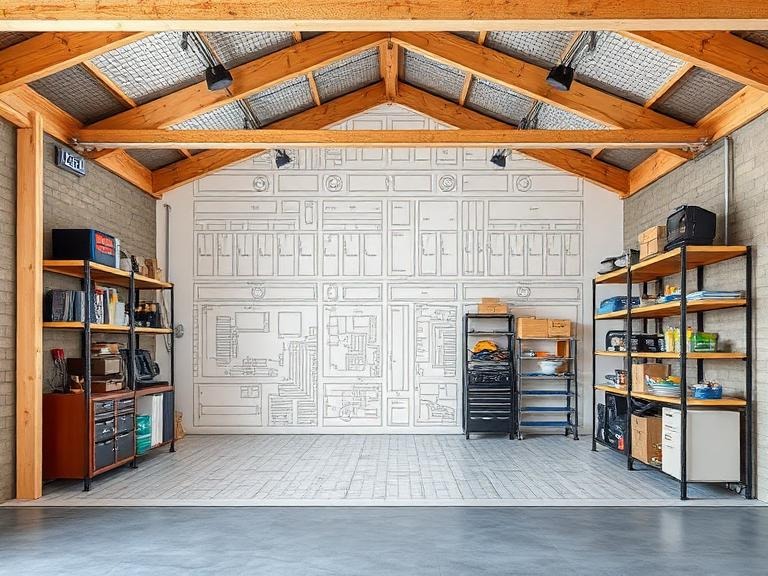
The decision to build a Garage with shelves begins on the drafting table. Before pouring concrete or erecting frames, you must define the exact purpose of the space. Will it house a single vehicle and weekend gardening tools, or will it serve as a dual-bay automotive restoration workshop? Accurate spatial mapping is non-negotiable. You must calculate the exact dimensions of your vehicles with all doors fully open, factoring in the rear tailgate swing arc.
We recommend establishing distinct zones during this blueprint stage. A minimum of 900mm (approximately 3 feet) of clearance should be maintained between your vehicles and the front face of your storage units to allow for safe pedestrian transit and tool retrieval. If your width is constrained, you must plan to build a Garage with shelves utilizing a vertical methodology—exploiting the ceiling height with tall, shallow-depth units rather than deep, floor-consuming racks.
Phase 2: Structural Framing and Load-Bearing Engineering
If you intend to build a Garage with shelves that will support engine blocks, heavy power tools, or bulk fluid containers, standard residential framing may be insufficient. In a typical build, timber or steel studs are spaced at 600mm intervals. However, when you build a Garage with shelves integrated into the wall structure, we recommend reducing the stud spacing to 450mm in the designated storage zones.
Furthermore, from our experience dealing with high-capacity installations, integrating horizontal noggins (blocking) between the vertical studs at the exact heights where your storage units will be anchored is a game-changer. This structural backing allows you to drive heavy-duty lag bolts directly into solid timber or heavy-gauge steel across the entire length of the wall, rather than hunting for isolated studs. This proactive framing strategy ensures that when you mount overhead units or tall racks, the sheer stress is distributed evenly across the primary load-bearing wall.
Phase 3: Flooring Preparation and Moisture Mitigation
A critical, yet frequently overlooked, step when you build a Garage with shelves is the preparation of the concrete slab. Concrete is porous and constantly wicks moisture from the underlying soil. If you place heavy steel shelving directly onto untreated concrete, the base plates will inevitably succumb to galvanic corrosion and rust over time, compromising the structural integrity of the entire unit.
Before installing any infrastructure, we strongly recommend applying a high-quality, commercial-grade epoxy coating or a penetrating silane-siloxane sealer to the concrete. This creates an impermeable moisture barrier. Additionally, finishing the floor prior to erecting your storage systems means you will not have to empty and disassemble massive, heavy racks a year later to paint the floor. When you build a Garage with shelves, the sequence of operations is just as important as the materials used.
Phase 4: Selecting the Right Storage Infrastructure
As Australia’s leading shelving supplier, Steel Power Shelving understands that the heart of your project lies in the hardware. To properly build a Garage with shelves, you must categorize your inventory and select specific infrastructure engineered for those loads.
Metal Shelving: For general-purpose items, bulk household overflow, and boxed inventory, high-grade Metal Shelving offers immense versatility. We engineer our metal units with adjustable tier heights, allowing you to reconfigure the vertical spacing as your storage needs evolve over the years. Look for powder-coated finishes that resist chipping and ambient humidity.
Garage Shelving: When dealing with heavier items such as automotive parts, paint cans, and power tool cases, dedicated Garage Shelving is required. These units utilize thicker gauge steel profiles and often incorporate bracing cross-beams beneath each shelf deck to prevent bowing under sustained, heavy static loads. Because our comprehensive range is backed by our own local delivery team in Brisbane, you receive these heavy-duty components directly to your site without the logistical nightmares of third-party freight.
Garage Cabinets: To build a Garage with shelves that also looks pristine and secure, integrating Garage Cabinets is essential. Cabinets provide dust-free, lockable environments for hazardous chemicals, expensive diagnostic equipment, and sharp tools. A hybrid layout—combining open racking for rapid visual access with enclosed cabinets for secure storage—represents the most professional and functional approach to outfitting your space.
Phase 5: Proper Anchoring and Assembly Techniques
The final physical step to build a Garage with shelves is the assembly and anchoring process. The tallest and deepest shelving units inherently possess a high center of gravity, particularly when fully loaded. In the event of an accidental vehicle bump, human collision, or seismic activity, unanchored shelving can become a lethal hazard.
We recommend mechanically fastening all tall storage systems to the structural framework of the building. If you followed our advice in Phase 2 and installed structural noggins, you can use high-tensile lag screws to bolt the upright posts directly to the wall. If you are anchoring into a masonry or brick wall, you must use expanding dynabolts or chemical anchors rated for high sheer capacity. Never use standard plastic drywall anchors to secure industrial-grade storage infrastructure. Our robust after-sales support team is always available to guide our clients through proper, safe anchoring methodologies to ensure a seamless experience from purchase to installation.
Expert Advice: Optimizing Your Workflow Zones
To truly build a Garage with shelves that elevates your property’s value, you must organize the space based on operational workflow. Group your infrastructure logically. Create a “Dirty Zone” near the main garage door for gardening equipment, soil, and outdoor tools, utilizing open Metal Shelving for easy cleaning. Create a “Clean Zone” deeper inside the garage for woodworking, detailing, and mechanical repairs, utilizing enclosed Garage Cabinets to protect your sensitive tools from ambient dust.
By treating the project holistically and deciding to build a Garage with shelves as a unified architectural goal, you eliminate clutter, streamline your workflow, and create an environment that is a joy to work within.
Frequently Asked Questions (FAQs)
What is the best material to use when I build a Garage with shelves?
While timber can be used for basic, light-duty applications, we strongly recommend industrial-grade powder-coated steel. Steel is impervious to termites, will not warp under heavy static loads or humidity changes, and offers a vastly superior weight-to-volume ratio. Our specialized metal and garage racking systems are designed to outlast the building itself.
How deep should my shelving be for a standard two-car garage?
When you build a Garage with shelves, the depth is dictated by your vehicle clearance. For the side walls where car doors must open, we recommend a shallow depth of 300mm to 400mm. For the rear wall (facing the nose of the vehicles), you can typically safely install deeper units ranging from 500mm to 600mm to accommodate large storage tubs and heavy equipment.
Can Steel Power Shelving assist if I am located in Brisbane?
Absolutely. We are based in Brisbane and operate our own local delivery team. This ensures that when you are ready to build a Garage with shelves, your heavy-duty infrastructure arrives safely and on schedule. Our local expertise and personalized care mean we provide unmatched after-sales support throughout your entire installation process.