

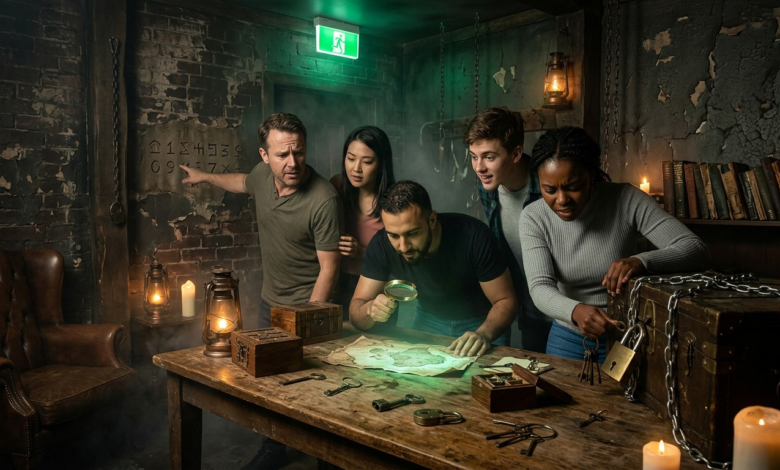
A well-designed horror escape room in Adelaide is not only a series of challenges. It is a change in cognitive processing. This is especially true for Klemzig, where a group of people may come for an evening session. Within a matter of minutes, a change is observed. The puzzles that were once manageable in a non-descript setting suddenly become complex, fragmented, and slow.
How Fear Changes Cognitive Performance
Fear is not just an emotional response. Working memory, attention span, and speed of decision-making are all impacted directly from the brain when in a horror scenario where the brain will give priority to survival cues. The brain will pay more attention to sounds; shadows; and sudden movements rather than logical and rational thought in these situations. This reduces the mental bandwidth available for solving escape room puzzles.
Players may:
- Miss obvious clues
- Forget previously discovered information
- Struggle to connect patterns
In a regular room, attention is always focused. However, in a horror escape room, attention is always divided.
Environmental Design in Horror Escape Rooms
In Klemzig, escape rooms are designed with controlled lighting, a confined environment, and sound effects. These elements are not decorative. They are functional.
- Low lighting creates a lack of visual clarity.
- Sound effects distract the player at critical moments.
- Spatial restrictions add pressure and restrict movement.
All these factors contribute to increasing the perceived level of difficulty of a simple puzzle.
The Role of Time Pressure and Anticipation
Time pressure exists in every escape room. In a horror setting, it is amplified by anticipation.
Players are not only racing against the clock; they are also bracing for the unknown.
This anticipation results in:
- Faster but less accurate decisions
- Less cooperation between team members
- More hesitation in reacting to objects
- This leads to less efficient puzzle solving.
The challenge is no longer just logical. It becomes psychological.
Group Dynamics Under Stress
Team behaviour changes significantly inside a horror escape room.
In calmer environments, teams tend to divide tasks and communicate clearly. Under stress, communication shortens. Instructions become unclear or incomplete.
Some players take control. Others withdraw.
This imbalance affects how quickly escape room puzzles are solved. A puzzle that requires shared input may stall if communication breaks down.
Are the Puzzles Actually Harder
In most cases, the puzzles themselves are not more complex. The perceived difficulty comes from the environment.
This is a balancing act that game designers often have to perform. The logic behind solving the puzzles still makes sense and is achievable within the allotted time.
Fear, however, introduces conflict between the player and the solution. This conflict is what makes it harder.
Why Players Still Choose Horror Escape Rooms
Despite it being harder, horror remains a popular choice in Adelaide.
Players seek:
- A greater emotional impact
- A greater sense of immersion
- A more memorable group experience
The experience is more rewarding because it is challenging under pressure.
For some, solving the puzzles in a horror-themed room becomes less about speed and more about control under pressure.
FAQs
1. Why are puzzles more difficult in horror escape rooms?
Fear causes distraction, which affects concentration and working memory. The fear of the horror atmosphere distracts the players, causing them to lose focus on the puzzles. This makes the puzzles seem more difficult.
2. Do horror escape rooms focus more on atmosphere than puzzles?
No, horror escape rooms are based on puzzles, just like the rest of the escape rooms. The atmosphere makes the puzzles more difficult, but the puzzles are still based on logic.
3. Are horror escape rooms suitable for beginners?
Yes, horror escape rooms are suitable for beginners, but they are more challenging for beginners because of the fear they experience while in the room. The puzzles are, however, not difficult, so the beginners can still manage, especially if they choose a moderate level of difficulty.