Strain Gauges vs. Optical Sensors: Which Sensing Technology Is Better for Industrial Monitoring?

Industrial monitoring relies on accurate, real-time data to ensure safety, efficiency, and performance across sectors such as manufacturing, construction, energy, and transportation. When it comes to measuring parameters like strain, pressure, temperature, and vibration, two technologies are commonly compared: strain gauges and optical sensors. Understanding the differences in strain gauges vs. optical-sensors helps industries choose the right solution for their specific monitoring needs.
Understanding Strain Gauges
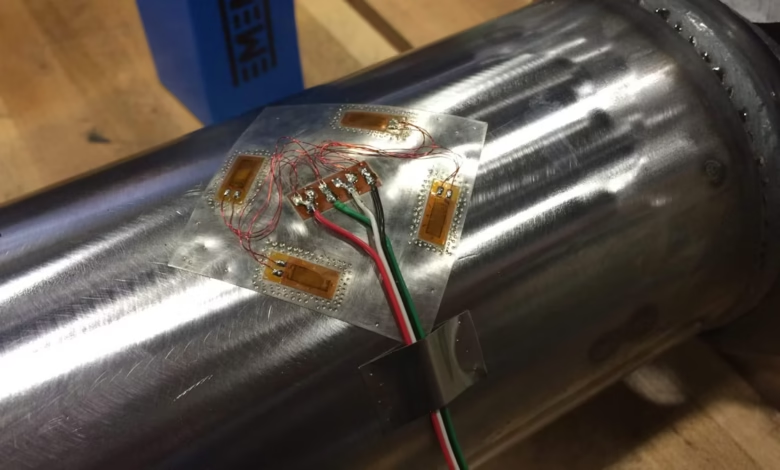
Strain gauges are traditional sensors that measure deformation by detecting changes in electrical resistance when a material is stretched or compressed. They are widely used due to their simplicity, affordability, and proven reliability. Strain gauges are generally attached to the surface that is to be measured; this makes them very good for localized measurements and controlled measurement setups.
Such sensors are used in load testing, analysis of structures, and monitoring mechanical parts. Moreover, over long distances, the signal can deteriorate due to noise pickup, which might restrict their use in large or harsh environments.
What are Optical Sensors
Optical sensors, to which fibre optic sensors belong, utilize light as a means of measuring physical changes such as strain, temperature, or pressure. One major benefit of these sensors is their resistance to electromagnetic interference, which makes them suitable for use in areas with a lot of electrical equipment or high-voltage systems. Furthermore, optical sensors can send data over long distances with very slight signal loss.
In the case of industrial monitoring, optical sensors are gaining more ground for structural health monitoring, pipelines, power plants, and remote sensing, among others. They can enable distributed sensing, enabling measurements not only at a single point but also across long stretches of infrastructure. Although optical sensors have a higher initial cost than their counterparts, they still tend to offer greater long-term value because of their durability, accuracy, and fewer maintenance needs.
Accuracy, Reliability, and Environment
While comparing the two technologies to one another, the difference between them comes down to the prevailing environmental conditions; both can deliver high accuracy when properly installed and calibrated. Strain gauges are well-suited for stable, low-interference settings and where budget constraints are a priority. On the other hand, optical sensors are often the preferred choice in harsh, high-noise, or remote environments where reliability and data integrity come first.
Installation and Maintenance
Strain gauges need thorough surface preparation and calibration, and they might wear out or be damaged by environmental exposure; therefore, periodic replacement may be necessary. In contrast, professional installation of optical sensors requires specialized knowledge and is quite costly initially, but usually the service life is long and the maintenance cost is low. That is why they are so attractive for long-term monitoring projects.
Companies working in this industry, like AusOptic, provide advanced sensing and fibre-based solutions, helping industrial clients select and implement technologies that balance performance, reliability, and operational needs.
Conclusion
There is no one-size-fits-all answer when evaluating strain gauges vs. optical-sensors. Strain gauges remain a cost-effective and reliable choice for many traditional applications, while optical sensors offer superior performance in demanding, large-scale, or interference-prone environments. The best sensing technology ultimately depends on application requirements, environmental conditions, and long-term monitoring goals.