

You have cleaned the bathroom. You have washed the curtains. You have even thrown out the bin early. But that damp, stale odour is still in the home, greeting you every time you walk through the door.
If this sounds familiar, you are not alone. Musty smells are one of the most common complaints from Sydney homeowners, and they are also one of the most misunderstood. Most people treat the smell. The problem keeps coming back. That’s because the smell is a symptom and the cause is usually somewhere you haven’t looked yet.
This guide covers what actually causes musty odours in Sydney homes, what you can do yourself, and when the problem needs more than a spray bottle and an open window.
Why Sydney Homes Are Especially Prone to Musty Smells
Sydney’s climate creates near-perfect conditions for moisture problems. Hot, humid summers particularly in coastal suburbs and the inner west combine with heavy winter rainfall and the clay-heavy soils found across much of Greater Sydney. Clay doesn’t absorb water well. Instead, it holds it at ground level, right beneath the foundations of your home.
Add to this the fact that a large portion of Sydney’s housing stock consists of older weatherboard and brick homes built on suspended timber floors often with minimal subfloor ventilation designed into them, and you have the ingredients for persistent damp that no amount of cleaning will permanently fix.
Common Causes of Musty Smell in the House
Before reaching for the air freshener, it’s worth pinpointing the actual source. Here are the most frequent culprits.
Mould and mildew are the most common cause. Mould releases gases called microbial volatile organic compounds (MVOCs) as it grows and that earthy, damp smell is those gases entering your living space. The mould itself might be visible on a wall or skirting board, or it might be hidden in a cavity, behind a cupboard, or underneath the floor.
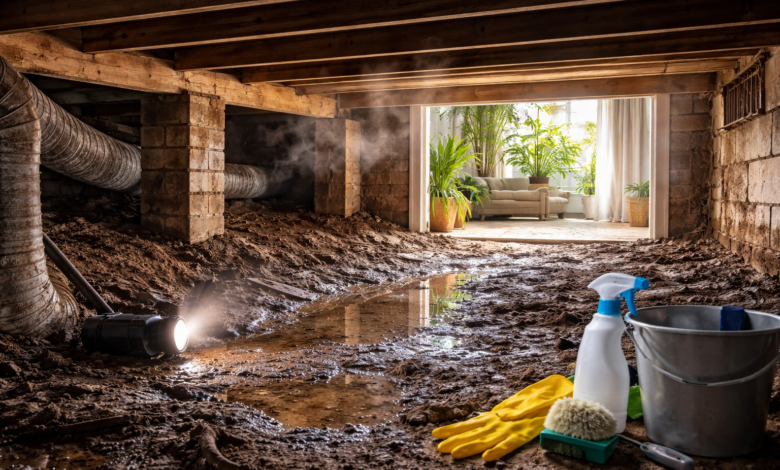
Trapped moisture under the floor is the underlying cause that most homeowners miss entirely. If your home has a subfloor, the crawl space between the ground and your floor level, damp air can build up down there and travel upward through gaps in floorboards, around pipes, and along wall cavities. You smell it in the living room, but the source is metres below your feet.
Poor airflow throughout the home allows stale, humid air to sit in corners, under-bed spaces, and enclosed rooms. Without fresh air moving through, moisture has nowhere to go.
Water leaks from plumbing, gutters, or rising damp in external walls introduce moisture into building materials that then develops mould over time.
Damp soft furnishings like rugs, sofas, and mattresses absorb moisture from the air and hold it, releasing that musty odour gradually. This is usually a secondary problem caused by one of the above.
What You Can Do Yourself Right Now
For surface-level or room-specific musty smells, these steps can make a real difference.
Ventilate every room properly. Open windows and doors on opposite sides of the house to create cross ventilation. Do this especially after rain, during humid weather, and first thing in the morning. Exhaust fans in bathrooms and kitchens should be used every time — not just when it’s steamy.
Check for visible mould and treat it immediately. Look around window frames, in bathroom grout, behind furniture against external walls, and along skirting boards at floor level. Surface mould on hard materials can be cleaned with a solution of white vinegar or a mould-specific cleaner. Dry the area thoroughly after cleaning.
Reduce indoor moisture sources. Avoid drying laundry inside. Don’t leave wet towels on floors. Cover pots when cooking. These small habits have a cumulative effect on indoor humidity.
Use baking soda in enclosed spaces. An open container of baking soda placed in a wardrobe or cupboard absorbs odours and light moisture. It won’t fix a moisture problem, but it can help in already-clean, enclosed spaces.
Clear blocked passive vents. If your home has air bricks or vents around the base of the exterior walls, check that they’re not blocked by soil, mulch, or garden beds. These vents allow airflow into the subfloor and blocking them even partially can significantly reduce ventilation beneath the house.
When DIY Fixes Don’t Work and Why
If your musty smell comes back after cleaning, or gets worse after rain and humid weather, the problem is almost certainly not a surface issue. It’s a moisture and airflow problem and it’s likely coming from beneath the house.
In Sydney homes with suspended timber floors, the subfloor is the single most common origin point for persistent musty odours. When damp air gets trapped in the crawl space beneath your home, it has nowhere to go. Moisture accumulates in the soil, gets absorbed into timber joists and floorboards, and creates the ideal environment for mould to grow out of sight, but very much within smell.
Most people try a dehumidifier at this point. Dehumidifiers can reduce indoor humidity in a room, but they don’t address what’s happening underneath the floor. They’re managing a symptom in your living area while the source continues generating damp air from below. As soon as you turn it off, the smell creeps back.
The other giveaway that subfloor moisture is involved: the smell is worse in ground-floor rooms, near skirting boards, or close to floor level. It intensifies after heavy rain or during humid stretches in summer. And it’s been happening for months or years, not days.
Subfloor Connection Sydney Homeowners Don’t Know
Here’s what’s actually happening in many older Sydney homes when that musty smell won’t go away.
Moisture from the ground below your house evaporates upward into the subfloor space. If there isn’t enough airflow in that crawl space to carry the moist air away, it sits there. Timber absorbs it. Mould grows on the joists and the underside of your floorboards. Then, through the natural movement of air in a building known as the stack effect that damp, mould-laden air rises into your living spaces.
You clean the skirting boards. The mould comes back. You clean them again. It keeps returning. That’s not a cleaning failure that’s a ventilation failure happening directly beneath you.
This is why a professional subfloor moisture inspection is often the most important step a Sydney homeowner can take when a musty smell persists despite all surface efforts. It identifies exactly what moisture levels and airflow conditions exist beneath the home, so the cause is treated, not just the symptom.
Long-Term Solutions That Actually Work
Once you know the source, the fix becomes straightforward.
- For subfloor moisture in Sydney homes, a properly designed mechanical ventilation system actively removes damp air from beneath the house and replaces it with drier outside air. Unlike passive vents, which rely on wind and natural airflow often insufficient in Sydney’s sheltered suburban streets, a mechanical system creates consistent airflow regardless of weather conditions. Homeowners typically notice the musty smell reducing within the first few weeks of installation as the subfloor gradually dries out.
- For mould on surfaces, professional treatment addresses the root cause rather than just killing the visible growth. Surface mould that keeps returning after cleaning is almost always fed by an ongoing moisture source and until that source is controlled, it will keep growing back.
- For general indoor humidity, improving whole-home ventilation through exhaust fans, window habits, and removing moisture sources provides a long-term improvement to air quality that dehumidifiers simply can’t match.
Signs the Problem Is Under Your House
If you are unsure whether subfloor moisture might be involved, watch for these specific signs:
- The musty smell is strongest near floor level or in ground-floor rooms
- It gets noticeably worse after rain or during humid summer weather
- Mould appears on the bottom section of walls or on skirting boards repeatedly
- Your timber floors feel slightly springy, soft, or warped in places
- The house feels generally damp or cold despite adequate heating
- You’ve been dealing with the problem for more than a few months
Any combination of these points strongly suggests a subfloor moisture problem rather than a surface issue.
What actions to take next
If you have tried the DIY fixes and the smell keeps returning, stop spending time and money masking the problem and get the right diagnosis first.
A free professional inspection will tell you exactly what’s happening beneath your home, moisture levels, airflow conditions, and whether ventilation is the right solution for your specific property. Sydney homes vary significantly in their subfloor layout, soil conditions, and access constraints, which is why a one size fits all approach rarely works.
For Sydney homeowners dealing with persistent musty smells, recurring mould, or damp that won’t shift, a professional subfloor ventilation Sydney assessment is the logical next step and with no call-out fees and no obligation, there’s nothing to lose by getting a clear, honest picture of what’s actually going on under your home.