
When a body panel on your 70 Series needs replacing, whether it’s a rusted door, a cracked bonnet, or a bashed guard you’ll quickly face the same decision every Cruiser owner faces eventually: go genuine OEM from a Toyota dealer, or go aftermarket?
Both options have real merit. Both have real trade-offs. And for a vehicle platform as widespread as the 70 Series, making the right call depends on what you’re actually trying to achieve.
What OEM and Aftermarket Actually Mean
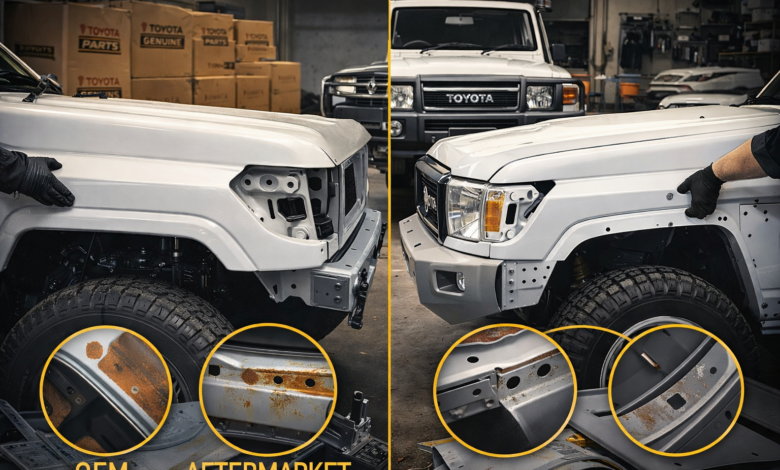
OEM (Original Equipment Manufacturer) parts are genuine Toyota parts, supplied through dealerships and sourced from the same manufacturers that built your vehicle originally. They are an exact match to what came on the vehicle from the factory same steel spec, same dimensions, same finish.
Aftermarket parts are manufactured independently, designed to fit and function like the OEM part without the Toyota badge or dealership price tag. Quality varies widely across the aftermarket from cheap imports with poor fitment to purpose-built replacements specifically engineered for Australian conditions that match or exceed OEM standards.
Understanding that distinction matters. When people say “aftermarket is risky,” they’re usually talking about the low end of the market. When they say “aftermarket is the smart buy,” they mean quality-sourced parts from reputable specialists. The two aren’t the same thing.
The Case for Genuine OEM Panels
OEM panels have a clear appeal. They are guaranteed to fit, no adjustments, no shimming, no fettling with hinges. Every mounting hole lines up exactly. The panel gaps match the factory specification. If your vehicle is still under warranty, fitting genuine parts keeps things straightforward with the dealer.
For late-model 79 Series owners particularly those with newer GXL variants, OEM parts also mean colour-coded panels that match the factory paint code precisely. If you’ve just had a panel bent in an accident and the rest of the vehicle is in near-new condition, a genuine replacement is a sensible way to return it to that standard cleanly.
The downsides are significant, though. Genuine Toyota panels are expensive often two to four times the cost of a quality aftermarket equivalent. For an older 75 Series or a high-mileage work ute, paying genuine dealer prices for a door or bonnet is difficult to justify. Availability is another issue. Panels for older 75 Series and early 79 Series variants can have long lead times through the dealer network, and some parts are no longer stocked at all for older build dates.
The Case for Quality Aftermarket Panels
For the vast majority of 70 Series owners in Australia, a quality aftermarket panel is the smarter buy and not just because of price.
The 70 Series platform has been in continuous production since 1984. That extended production life means the aftermarket has had decades to refine fitment. Good aftermarket suppliers have measured, tested, and refined their panels against the factory originals across multiple production runs. The result is aftermarket panels that install cleanly, match factory dimensions, and in some cases improve on the original with better seam sealing, full primer dipping for rust resistance, and heavier gauge steel than what Toyota originally used on older variants.
For restoration work on older 75 Series and 79 Series builds, aftermarket is often the only practical option. Genuine replacement panels for a 1990s 75 Series simply don’t exist through Toyota anymore. Aftermarket suppliers fill that gap, and they do it at a price that makes a full body restoration financially viable rather than prohibitive.
The cost difference is substantial. A genuine dealer door for a 79 Series single cab can cost well over $1,000 through a Toyota dealer before paint. A quality aftermarket equivalent, primer dipped and ready for topcoat, comes in at a fraction of that. For owners replacing multiple panels as part of a restoration, those savings compound quickly.
Where Aftermarket Panels Can Fall Short
This is where honest advice matters most. Not all aftermarket panels are equal, and the 70 Series market has its share of cheap product sourced with little regard for fitment or material quality.
The most common issues with low-quality aftermarket panels are:
Poor fitment: Panel gaps that don’t match the factory specification, mounting holes that are slightly off, or door skins that require significant adjustment to hang correctly. Minor adjustments are normal with any aftermarket panel, but large gaps or binding hinges indicate a poorly manufactured product.
Thin or substandard steel: Some imported panels are made from thinner steel than the OEM spec. On a vehicle that does real work, carrying loads, crossing creeks, taking hits on bush tracks, thin panels dent and damage more easily and offer less structural contribution.
No corrosion preparation: Cheap panels arrive with a light coat of spray primer that doesn’t penetrate seams or protect the internal surfaces. Rust can establish itself in the seams and inside cavities within a couple of years.
The solution is simply to buy from suppliers who are transparent about their product. Quality aftermarket panels for the 70 Series are built to OEM steel gauges, fully primer dipped (meaning the whole panel is immersed in primer, not just surface sprayed), and have seam sealing applied during manufacture. These are the details that separate a panel that lasts 20 years from one that starts bubbling in three.
A Practical Comparison by Panel Type
Doors: Aftermarket wins for older variants, OEM worth considering for late-model vehicles still under warranty. A primer-dipped aftermarket door with side intrusion bars is a genuine like-for-like replacement for any 70 Series restoration or repair.
Bonnets: Aftermarket is the clear choice. Bonnets are straightforward panels with minimal fitment complexity, and quality Aftermarket bonnets and guards are widely available for every series variant from the 40 Series through to the current 79 Series. The cost savings over genuine ones are significant.
Guards and Inner Guards: Aftermarket is practical here, but fitment matters more than on flat panels. A good aftermarket guard will bolt straight on; a poor one will require fettling to align correctly with the door gap and headlight surround. Buy from a supplier who knows the specific variant you’re working on.
Tubs: Genuine tubs are rarely available for older 75 Series variants, making aftermarket the only practical path. A full replacement tub from a quality supplier is a better outcome than patching a rusted original.
Cabin Panels A Pillars, sill panels, and windscreen frames have more fitment sensitivity than exterior panels. These are worth investing in quality aftermarket product specifically manufactured for the 70 Series, not generic panel sections.
What Land Cruiser Owners Should Do
For late-model 79 Series or 76 Series vehicles that are relatively new, under warranty, or in otherwise excellent condition, OEM panels make sense when the budget allows, particularly for visible panels where paint match and gap quality matter most.
For the majority of 70 Series owners, those restoring older 75 Series builds, replacing panels on high-mileage work vehicles, or managing a budget-conscious repair quality aftermarket is the right call. The savings are real, the fitment is solid when you buy from the right supplier, and the corrosion protection on good aftermarket panels is often better than what the factory originally applied on older vehicles.
The key is not choosing between OEM and aftermarket as categories. It’s choosing the right supplier within the aftermarket space. Look for primer-dipped panels, OEM steel gauges, and a supplier who can confirm fitment for your specific series and build date before you order.
For a comprehensive range of aftermarket body panels for the LandCruiser 70 Series covering doors, bonnets, guards, tubs, and cabin panels across the 40 through to 79 Series, the team also offers free expert consultation to confirm the right part for your specific build before you commit.